Greenline in Wastewater Treatment for Pollution Control - Improving Environmental Quality Through Advanced Chemical Dosing Solutions
Executive Summary
Wastewater treatment facilities play a critical role in maintaining environmental health by ensuring treated water is safe for discharge into natural ecosystems. However, odor emissions natural to treatment processes can negatively impact surrounding communities. This white paper explores how Greenline pumps enhance odor control systems by delivering precise chemical dosing for odor mitigation and pH control, ensuring cleaner air and improved quality of life.
By integrating Greenline pumps into odor control systems, operators achieve reliably cleaner air and improved regulator compliance and community relations. Compared to similar competitor pumps, Greenline delivers lower
purchase costs and significant savings on maintenance thanks to superior reliability and an extended mean time between failure.
Introduction
Wastewater treatment plants safeguard water resources and wildlife. Yet, as urban development expands, facilities once isolated are now surrounded by residential neighborhoods. Odors that previously went unnoticed—primarily from hydrogen sulfide (rotten egg smell) and ammonia—are now impacting communities, prompting complaints and stricter enforcement of odor management plans (OMPs).
In the U.S., federal regulations, nuisance laws, and local ordinances require wastewater treatment plants to monitor and control odor-causing compounds. Effective odor control is no longer optional—it is required for compliance and community trust.
Problem Statement
Odor emissions from wastewater treatment processes create
unpleasant conditions for nearby residents and plant employees. Beyond a nuisance,
these compounds can accelerate equipment corrosion and pose health risks,
making odor control a critical operational priority.
Background
Common odor control strategies include:
- Physical containment: Dome enclosures over basins and tanks to trap gases
- Emission treatment: Scrubbers to neutralize odors before release
- Chemical dosing:
- Hydrogen Peroxide (H₂O₂) and Sodium Hypochlorite (NaOCl) for odor neutralization
- Sodium Hydroxide (NaOH) and Sulfuric Acid (H₂SO₄) for pH control
Reliable chemical dosing systems are essential for these strategies. However, the chemicals and odor-causing may be highly corrosive, requiring pumps that can withstand aggressive environments while delivering precise dosing.
Proposed Solution: Greenline Pumps
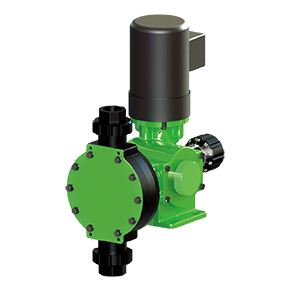
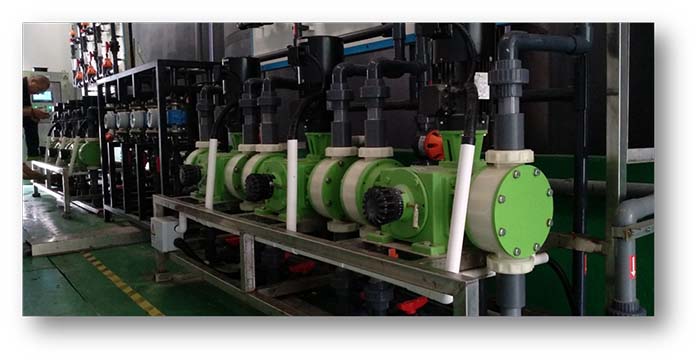
Greenline pumps are engineered for demanding odor control applications, offering:
- Capacity: Greenline has 7 hydraulic sizes, supporting flows as low as 3.2 GPH and up to 824 GPH, with pressures up to 170PSI.
- Materials of Construction:
- 316 Stainless Steel wet ends for durability and corrosion resistance
- PVDF wet ends for the most aggressive chemicals
- Key Advantages:
- Leak-proof design: Redundant gaskets and seals prevent internal and external leaks
- Unmatched accuracy: Automatic no-drift stroke adjustment ensures consistent dosing
- Extended component life: Nonmetallic coupling can be rotated to double lifespan, and prevent damage to the motor shaft and pump’s worm gear.
- Durable diaphragm: PTFE, consisting of 5-layers reinforced by 316 SS backplate, adding robustness, operational life and reducing the need for maintenance
- Safety features: Optional leak detection and manual bleed valve for reliable operation
Recommended Models: DM2A and DM2C for H₂O₂ and NaOH applications, delivering reliable performance in harsh environments.
Implementation
Integrating Greenline pumps into odor control systems involves:
- Assessing chemical dosing requirements
- Selecting appropriate pump models
- Installing and calibrating pumps for optimal performance
Conclusion
Integrating Greenline pumps into odor control systems involves:
Greenline pumps provide a robust, cost-effective solution for odor mitigation and pH control in wastewater treatment facilities. By ensuring accurate chemical dosing, they help maintain environmental standards, improve community relations, and protect public health—all while reducing maintenance costs and downtime, and within budget.
Contact us today to learn how Greenline can optimize your odor control strategy.